
Being chronically ill is a nightmare few experience. Living every day in pain, exhausted, unable to accomplish even the simple tasks sometimes. Especially when you look fine – no limbs out of joint, all your hair present and accounted for. Worse than the pain are the looks people believe you can’t see.
Anna had tried and tried to fix herself. She had been to so many doctors, from dermatologists to gastroenterologists. She had been x-rayed, eaten radiated food, given away a bathtub’s worth of blood. Each doctor promised that if she just had this test and tried that drug, this time would be it.
And at first, Anna let herself fill with hope after every new test and specialist. But now she wasn’t even sure why she continued with them. A sense of obligation, she supposed.
It was after one of her most recent appointments that Anna met the old man. She was walking across the parking lot at a diagonal, headed towards the bus stop just across the street, and she was walking quickly with her hands jammed deep into her pockets. Every time a patch of brittle leaves entered her path, she crunched down on it, hard. Spitefully.
As she neared the stop, she noticed the old man sitting on the bench. At first, she was confused. She had been staring fixedly at that bench, plastered with the ceramic-toothed smile of a local realtor, throughout her walk and she hadn’t noticed anyone sitting there until now. But then again, he was a rather small and nondescript old man, so it was possible she had just missed him in the glare of the realtor’s mega-watt grin.
“Hello,” he said pleasantly as she sat down carefully at the opposite end of the bench. His voice was dry and grandfatherly and Anna instantly warmed to it.
“Hi,” she returned. For a moment, they sat in silence, surveying the cars parked on the street. There was no bus in sight yet.
“They can’t fix you,” he broke the silence as though picking up in the middle of a conversation they’d left off earlier. Uncomfortable, worried the old man might be crazy, Anna continued to stare down the street. But the old man did not take the hint.
“They try, they really do. But modern medicine sometimes ignores the wisdom of the past, and then it gets itself stuck. I know your pain. I’ve seen it before. And I know how to fix it. But they don’t.”
Anna wondered how he could possibly know she was sick.
“I can smell you,” he continued, “rotting from the inside. That smell is so distinct that once you recognize it you can never forget it.”
A dark blue sedan sped past, driving far too fast for a residential neighborhood, but there was no one to reprimand it. Only a couple of crushed dry leaves left behind.
“Look,” he continued as though she were conversing with him this entire time. “You don’t have to try. But I want to give you the chance to get better. One day you will realize nothing else is going to work. So when that day comes, you’ll have to meet me back on this bench. I need something from you, though, and it will be hard. I need a toe. And really, that’s well worth your health, isn’t it?”
Just then the bus pulled up and its door opened with a squeak. Anna jumped up and turned to ask the man if he was serious, but there was no one on the bench.
She boarded the bus with a prickling feeling on her neck. By the time she got home, it had travelled all the way down her spine.
* * * * *
Anna could not get the old man off her mind. She tried, she really did, but he was constantly sneaking back in, beckoning his finger.
The doctors’ appointments marched on, and the brittle leaves were replaced by a gleaming layer of snow and ice. Although she continued to go to the same clinic, Anna never saw the old man at the bus stop again. Nowadays, she only had the realtor’s face to keep her company as she waited.
One day, she woke up and the pain was so intense it lit up her vision in vivid white. She could barely move, but she managed to drag herself unsteadily to the kitchen using the walls as support. As she stood at the refrigerator, the glint of the knife rack caught the corner of her eye and the old man popped into her head. He was smiling, and as he crooked one finger towards her, he pointed his other hand towards the knife rack. She stood still and so he took his crooked hand and gestured it towards her, and this time she took it.
She took the butchers knife from the block and tripped into a seated position on the tiles. A ray of sunshine came through the window and illuminated her, warming up her skin.
It was hard, harder than she had expected. But she needed the pain to stop, so she raised the butchers knife, gritted her teeth, and brought it down hard. Her pinky toe was left lying in a pool of blood, sparkling in the sunshine. She put it in a plastic bag, wrapped up the stump on her foot, and wiped the floor. Trembling, she went back to bed with the toe in its bag beside her, ready to deliver to the old man. As she lay in bed, she realized the pain was gone.
When she got back out of bed, it was still gone. Her foot ached and she could tell she walked a little differently now, but that was nothing compared to the feeling of being better. Anna looked down at the toe, lying on her bedside table, and smiled.
The next day, Anna rushed to the bench after her appointment. And there, on the bench, was the old man. As though he knew all along that today was the day.
“I’m sorry,” Anna said, for the first time turning to face him. “I’m sorry I thought you were crazy. You weren’t.”
The old man took the plastic baggie she offered and put it in his pocket without examining the contents.
“The pain just disappeared,” Anna was rambling, she felt awkward but she didn’t know how to stop. “I couldn’t – “ He raised a hand to cut her off.
“I am glad it is working,” the man said seriously. “But I need you to understand that it is a process. The pain will come back and you will have to continue.”
The bus pulled up and Anna turned to say that she could handle it, but her words hit empty air.
* * * * *
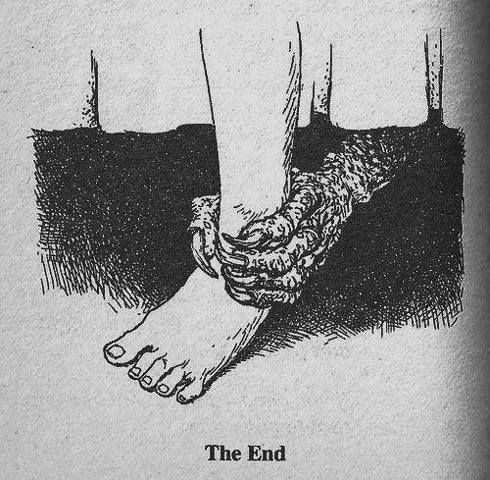
It only took a couple of days for the pain to come back, but this time Anna was ready. The third time, she accidentally chopped off two of her toes at once, and that is how she discovered that the more she chopped, the longer she felt better.
As winter melted into spring, and then summer, Anna continued chopping away. She had stopped attending appointments with her regular doctors, preferring instead to just visit the old man as needed. And the more she chopped, the less sick she became.
First, it was just her toes. And then the left foot, the left shin. She didn’t need her pinky fingers, so those went next. Each time she met the old man, he smiled and told her she smelled less rotted. And she knew he was right. She felt lighter than ever.
One day in August, the last day the pain came back, she realized she was running out of body. She would have to cut her left arm at the shoulder this time, and that would require a lot of strength. She braced herself up against the kitchen cabinets and raised the knife. It glinted in the sun, winking at her. Winking back, Anna brought it down. Again. And again. And again. Over and over until she was sure she’d hacked clean through because the knife had gouged into the cabinet behind.
The tiles had turned slick and pink with blood. Anna smiled at it, running her fingers to paint circle after circle. Eventually she started to feel tired, and so she lay down. Her clothes and hair became the same pink as the tiles, sunlight illuminating everything. Her eyes looked to the side following her right arm all the way to her fingertips. She could see that they were still making pink circles, but she couldn’t feel it.
The sun grew brighter and brighter. In the back of her mind she heard a knocking at the door but she ignored it. Instead, she watched the sun light up the pink circles so that they glittered. Anna closed her eyes and let the warmth wash over her. She smiled and waved to the old man, who winked back.
“Thank you,” she mouthed. He didn’t seem to hear her. But it didn’t matter because finally she was better.
 Plastic Barbie Girl